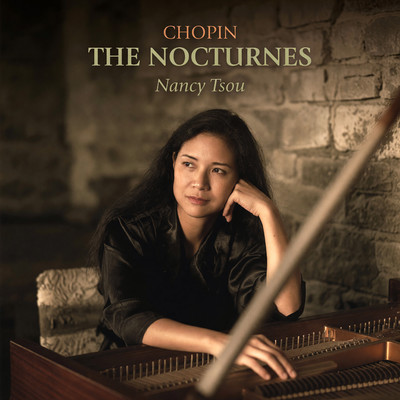
Listen & tracks
4 of 13 tracks have a preview · 13 works · 69:02
-
1 Nocturne, Op. Posth: in C sharp minor Frédéric Chopin 4:18
-
2 Nocturne, Op. 9: No. 1, in B flat minor Frédéric Chopin 7:01
-
3 Nocturne, Op. 9: No. 2, in E flat major Frédéric Chopin 5:15
-
4 Nocturne, Op. 9: No. 3, in B major Frédéric Chopin 7:07
-
5 Nocturne, Op. 15: No. 1, in F major Frédéric Chopin 4:44
-
6 Nocturne, Op. 27: No. 1, in C sharp minor Frédéric Chopin 5:18
-
7 Nocturne, Op. 27: No. 2, in D flat major Frédéric Chopin 5:45
-
8 Nocturne, Op. 32: No. 1, in B major Frédéric Chopin 4:44
-
9 Nocturne, Op. 32: No. 2, in A flat major Frédéric Chopin 5:35
-
10 Nocturne, Op. 48: No. 1, in C minor Frédéric Chopin 6:35
-
11 Nocturne, Op. 55: No. 1, in F minor Frédéric Chopin 4:40
-
12 Nocturne, Op. 55: No. 2, in E flat major Frédéric Chopin 4:08
-
13 Nocturne, Op. 72: No. 1, in E minor Frédéric Chopin 3:52
Under Nancy's hands Chopin hurts. The shadows of the bass intrude. The music can be very loud, and the emotional charge equals the climax of a full symphony compressed into a few minutes. There is suffering, and exaltation too, painful in its purity.
At the time of this recording she specialised in solo recitals and performed extensively in Australia and overseas. This selection of thirteen nocturnes ranges from the posthumous C-sharp minor through the familiar Op. 9 set to the late Op. 72, tracing Chopin's night music from early lyricism to darker, more dramatic ground.
In the artist’s words
We have to give the music all the power of our hearts, to make it live. The performer's task is to lead each member of her audience to the place where they are transfixed by the genius and the nobility of the composer.
Serenades are music for the evening and nocturnes are music for the night. Mozart's A Little Night Music is a nocturne and so is J. S. Bach's Goldberg Variations which sent the good Count to sleep. But from the end of the eighteenth century the notion of night itself began to change, and Chopin's Nocturnes were an agent in this change.
The new sciences of the Enlightenment had transformed how Europeans understood the human mind when it is awake and sensing the external world. Novalis' Hymns to the Night, Coleridge's Kubla Khan and The Rime of the Ancient Mariner attempted, instead, minute recreations of our interior lives. These Romantics brought back their private dream worlds across the gates of sleep into the waking world we all share.
In the daylight, our dreams during the night appear vague and grey. But to our sleeping selves they are quite as brilliant and real as our waking experiences. But, of course, no scientist has yet taken a light-meter across the gates of sleep to measure the brightness of dreams.
The issue is vital. Is a dream a faded shadow of our waking passions, or is it as vibrant or more vibrant than the waking world? Is dreaminess really a property of dreams themselves, or is it just a word used by the waking self for whatever it can hardly remember? On the answers to these questions may depend the dynamics and intensity with which a pianist plays a Chopin Nocturne.
These Romantics are hypnotists. Through metre and rhyme, or rhythm and harmony, they induce a slowing of respiration and the heart beat in their listeners. So we cross the Lethe stream of reverie, and beyond it is a great stillness. Within this stillness the often violent phantasmagoria of the artist is enacted. For as long as that state of stillness is maintained by the listeners, the artist has power over their minds and can lead them to realise the most fantastical imaginings. And that is how Chopin's Nocturnes seemed to their nineteenth-century critics. The critics were possessed by them as by magic. They found extraordinary parallels to describe their raptures, not always in a good way!
Chopin wrote more than twenty nocturnes and they are all substantial compositions. Few nocturnes were composed for the piano after Chopin. So it was a major form for him and one peculiar to himself and Field. Of these two, Chopin realised the potential in the nocturne form for the desperate and the macabre, and above all for the tremendous. In a fanciful passage, Wittgenstein imagines a picture of Beethoven composing Beethoven's Ninth Symphony. He then tries to imagine a picture of Goethe composing Beethoven's Ninth Symphony!
Like him, I find this impossible but I have little trouble imagining the Chopin of the Nocturnes doing so. A single piano achieves symphonic and choral effects of that order again and again in the briefest times.
"Chopin's Nocturnes give us everything we want from music and they give it to us instantly," says Nancy Tsou. Schopenhauer had argued that the greatness of Beethoven's Ninth Symphony was the length of the struggle within each movement before its resolution. The resolution achieved by a dancehall tune in five minutes was correspondingly trivial. The Nocturnes show that Schopenhauer was wrong. The time taken does not contribute to the power of the effect.
"Like an actor the pianist needs an inner poise before the Nocturne begins," says Nancy. "I am standing on ice. What follows is constantly and astonishingly inventive. But it is so economical and so precise that it is a completely coherent sequence. The Nocturnes are like the fugues of J. S. Bach. But the range of emotional colours in the Nocturnes is overwhelming." Nancy's art is to make all these colours blaze within the strictest elaboration of form. Dynamically and dramatically, she dares more in the Nocturnes than most performers.
Reviews
While not demanding technically, Chopin's Nocturnes contain pianistic pitfalls. Some artists over-prettify them – easy to do when the melodic line is highly decorated – and they can seem fragile and precious. Australian-based pianist Nancy Tsou avoids these traps by taking most at a reasonably fast pace. Tsou's incomplete but representative selection gives us just 13 of the Nocturnes. Her instrument is closely but beautifully recorded, aptly placing the listener in the front row at a chamber recital. In terms of dynamic shading and rubato, Tsou's playing reveals a genuine personal connection to the composer's spirit. The quasi-improvisational feeling and quiet inwardness are beautifully captured. ★★★½
Artists

Frédéric Chopin
composer
Frédéric Chopin (1810–1849) was a Polish composer and virtuoso pianist of the early Romantic period. He wrote almost exclusively for the piano and remains one of its defining poetic voices.

Nancy Tsou
piano
Nancy Tsou (pronounced "Zo") was born to a diplomatic family of the Republic of China (Taiwan). She began her musical education at age five, in Argentina, and continued her studies in Melbourne and New York.
Digital booklet
Digital booklet Notes, texts and credits — read online or download the PDF Download the PDFPerformers
- Nancy Tsou · piano
Details
- List price
- $25.00 AUD
- Total playing time
- 69 minutes 2 seconds
- Release date
- 1 Aug 2016
- Category
- Classical
- Musical work copyright
- © 2016 Nancy Tsou
- Sound recording copyright
- ℗ 2016 Move Records
- Catalogue
- MCD 546
- EAN
- 9314574054620
More to explore

The Latin Muse
Pianist Nancy Tsou brings fire and tenderness to Spanish and Latin American works by Piazzolla, Granados, de Falla, Albéniz and Ginastera. Chosen for intensity of feeling, the programme is played with deep sympathy for the Latin idiom.
Geoffrey Tozer in Concert: Canberra 1987
This live recording of pianist Geoffrey Tozer was made in June 1987, during a series of four recitals marking his twenty-fifth anniversary as a performer.

Kevin Kanisius Suherman presents Schimmel Konzert 219
Kevin Kanisius Suherman presents the new Schimmel Konzert 219 concert grand in a recital that sets Romantic and early twentieth-century piano works beside his own arrangements of Indonesian song.
Geoffrey Tozer in Concert: Takapuna 1996
A live 1996 concert from Takapuna captures Geoffrey Tozer with the Auckland Sinfonietta in Mozart’s Piano Concerto No. 27, framed by Chopin, Medtner, Schnabel, Gluck, Liszt and Bach.
Timeless
The title Timeless marks Tamara Smolyar’s personal reading of classic piano works she has lived with since childhood, offered for family and listeners alike, and the music’s power to cross generations and cultures.

Kevin Kanisius Suherman plays Schimmel Konzert 280
Young pianist Kevin Kanisius Suherman presents a full recital of Schumann’s Carnaval, Liszt, Chopin and Beethoven, recorded on the new Schimmel Konzert 280 concert grand.